Ever wondered how to identify indirect competitors before they take your customers ?Most business owners track the same three or four rivals every quarter. They compare prices, watch ad campaigns, and copy a feature or two. It feels like due diligence. But the company that quietly pulls your customers away may never show up on that list. Learning how to identify indirect competitors is one of the most useful habits you can build, because these rivals often sit in a completely different industry and still win the same customer, the same budget, and the same hour of attention.
In this guide, you will learn what indirect competitors are and how it is really important in digital marketing , why they are easy to miss, and a simple five-step process you can use this week.
What Are Indirect Competitors?
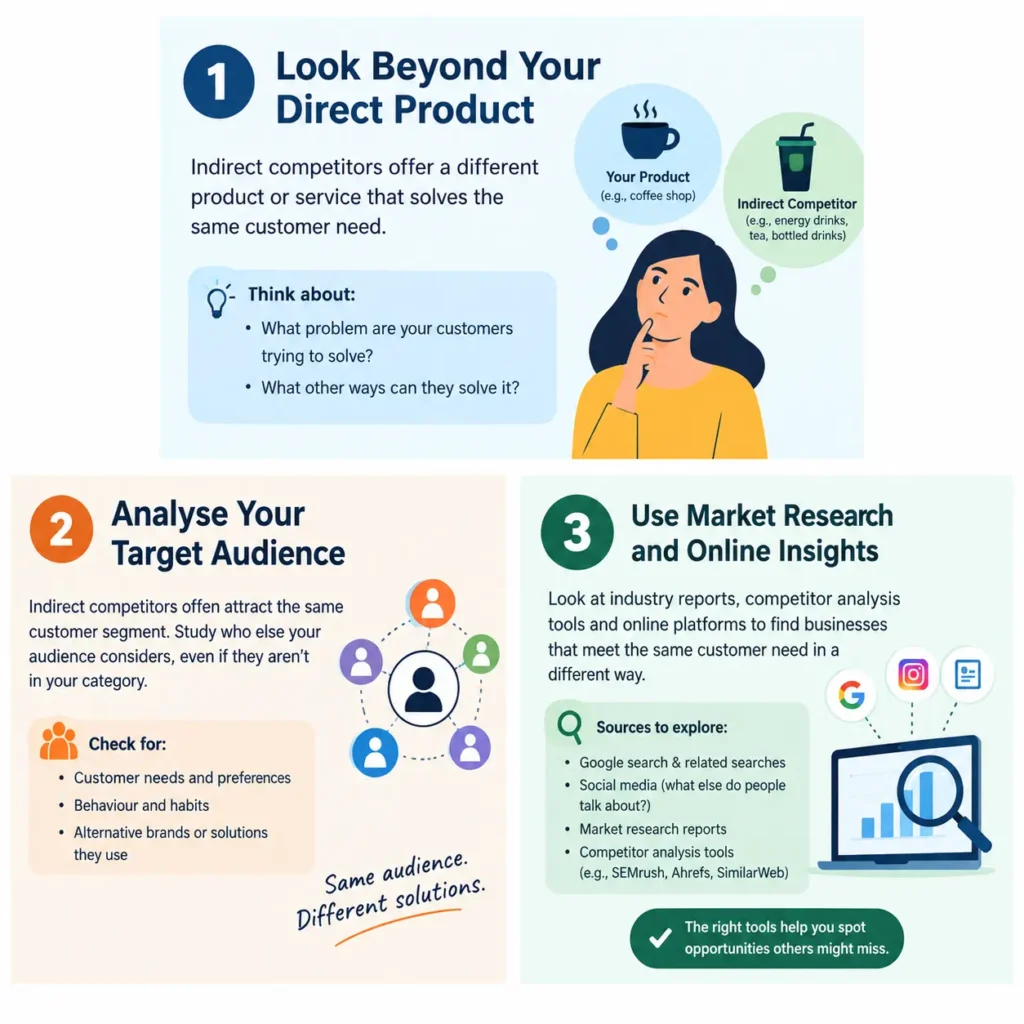
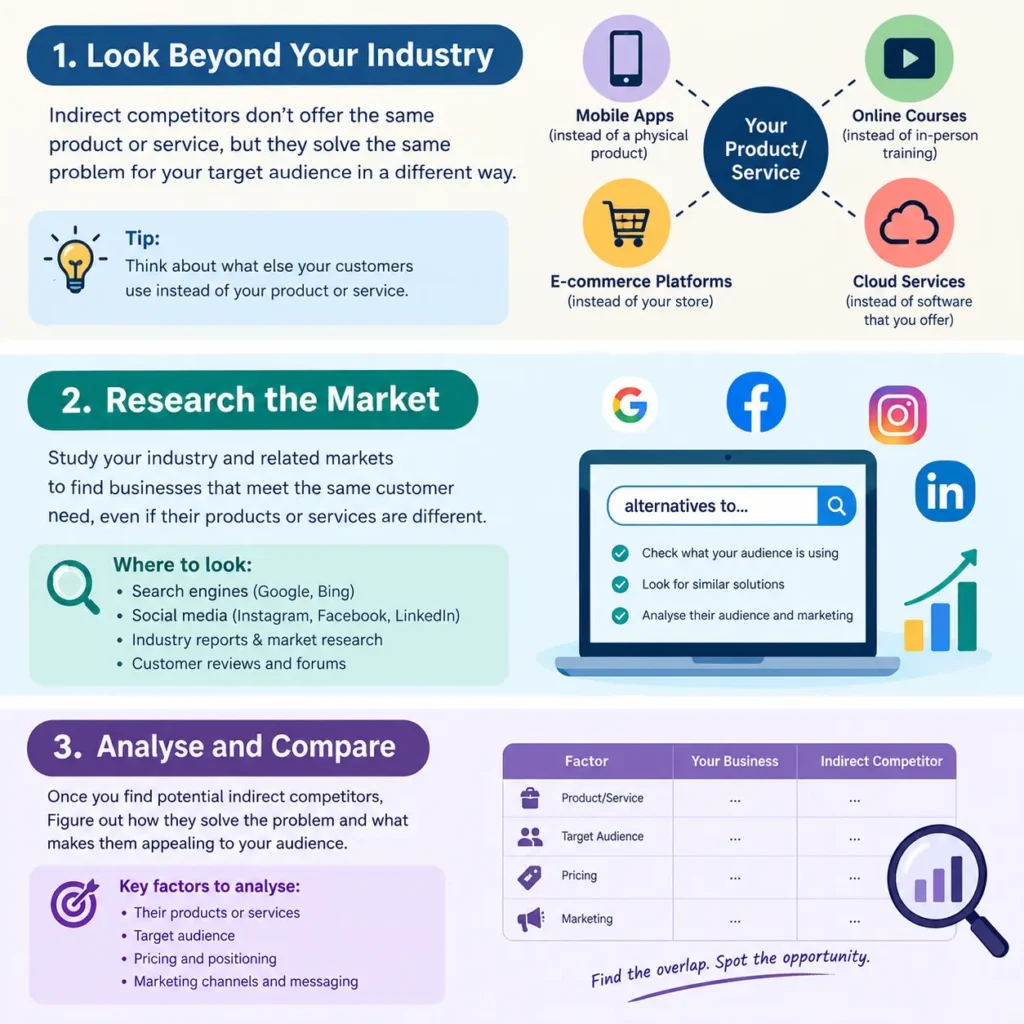
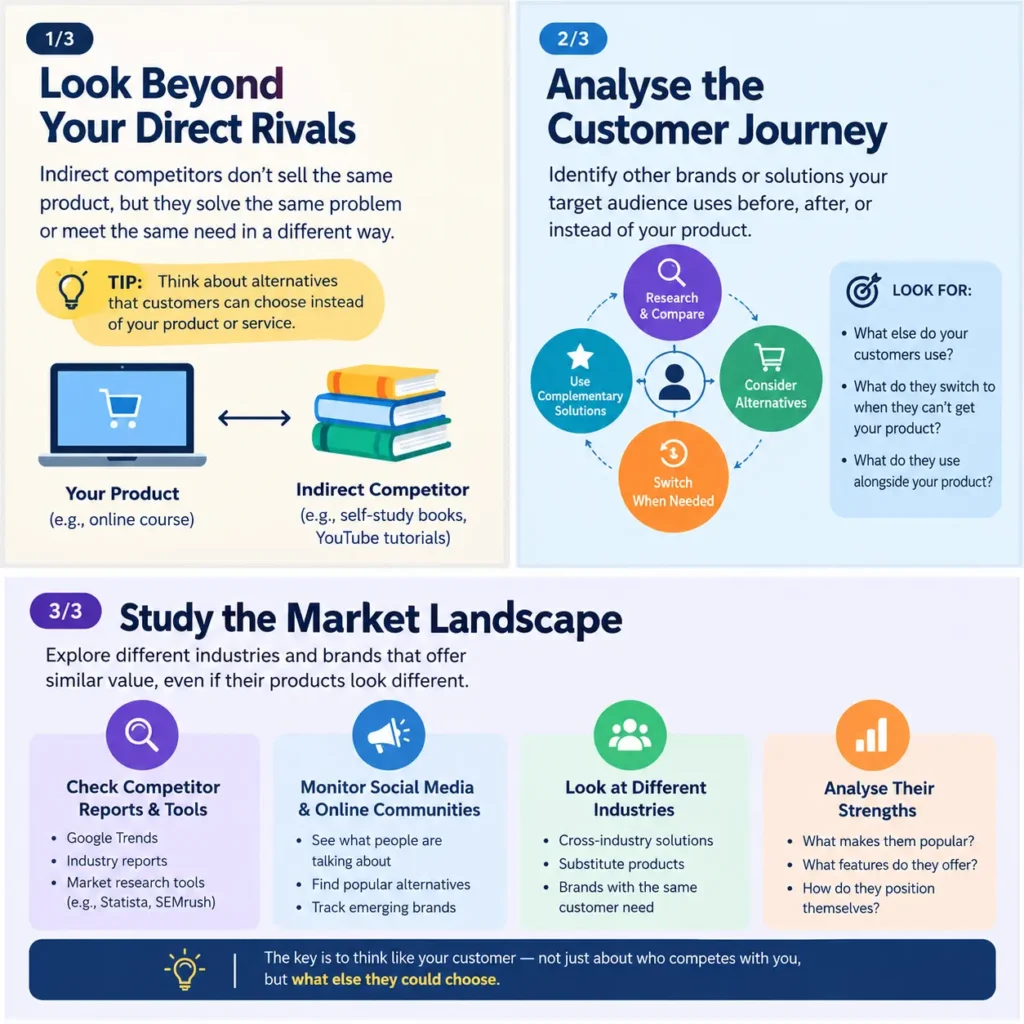
How to identify indirect competitors. Indirect competitors are businesses that solve the same customer problem as you, but in a different way. They do not sell your product, and they may not even share your industry. They compete for the same need, money, or time.
Here is how the three types of competition compare:
| Type | What they sell | Example (local gym) |
|---|---|---|
| Direct competitor | Same product, same audience | Another gym down the street |
| Indirect competitor | Different product, same need | A home workout app or a running club |
| Substitute / non-consumption | A different solution, or doing nothing | Free YouTube workouts, or skipping exercise altogether |
The line between indirect competitors and substitutes is blurry, and that is fine. How to identify indirect competitors What matters is the question behind both: what else could my customer do instead of buying from me?
Why Your Biggest Competitor May Sit Outside Your Industry
When you only benchmark against direct rivals, you are fighting the last war. How to identify indirect competitors. Customers do not think in industry categories. They think in problems and outcomes.
A few well-known examples make this clear:
- Kodak and the smartphone. Kodak competed with other film and camera makers for decades. The camera in a phone, which did not look like a competitor at first, changed how people take and share photos.
- Blockbuster and streaming. Blockbuster watched other rental chains. Streaming services changed the way people watched movies at home and reshaped the entire category.
- Netflix and sleep. In a 2017 shareholder letter, Netflix said it competes with sleep, along with other ways people spend their free time. That is indirect competition in its purest form.
Harvard Business Review’s overview of disruptive innovation explains how this pattern repeats: new entrants often start with a simpler or cheaper solution on the edge of a market, then move up. Michael Porter’s five forces framework also lists the threat of substitutes as one of the forces that shape an industry’s profits.
The lesson is simple. If you only watch direct rivals, you will see the threat last.
How to Identify Indirect Competitors: A 5-Step Process
This process works for a solo consultant and for a mid-sized company. You need a notebook and about an hour to understand how to identify indirect customers
- Define the job your customer hires you to do. Do not describe your product. Describe the outcome. A meal-kit company does not sell boxes of food. It sells “dinner without the stress.”
- List every other way customers get that job done. Include other products, free options, DIY methods, and doing nothing. For “dinner without the stress,” that list includes takeout apps, frozen meals, and a grocery pickup service.
- Ask your customers directly. Use a short survey or a few quick calls. Try: “Before you found us, what did you try?” and “What else did you consider?” Their answers will surprise you.
- Check search and social signals. Look at what shows up in search results for your customer’s problem, not your product name. Read community threads, reviews, and comment sections to see which alternatives people mention.
- Score each rival by overlap and threat. Rate every option from 1 to 5 on how closely it matches your customer’s need, and how fast it is growing. Focus on the high scorers.
This is the core of how to identify indirect competitors in a way that is practical, not theoretical.
A quick illustration
Imagine a small accounting firm that serves freelancers. How to identify indirect competitors. Its direct competitors are other local firms. But if you map the customer’s job, which is “stay tax compliant without a headache,” you will find that budgeting apps, online tax software, and even a freelancer’s own spreadsheet all compete for that job. The firm’s real threat may be the app a customer can set up in ten minutes. (This is a hypothetical example to show the method.)
Where to Find Indirect Competitors
If step four feels vague, here are specific places to look inorder to understand how to identify indirect competitors
- Customer interviews and sales calls. Note every alternative a prospect mentions, even if it seems unrelated.
- Google autocomplete and “People also ask.” These reveal the questions and alternatives real people search for.
- Review sites and forums. Read what people say when they compare options or explain why they switched.
- Your lost-deal notes. If you lose a sale, find out where the customer went. Sometimes the answer is “nowhere.”
- Your own analytics. Look at which pages visitors read before they leave, and which topics they search for on your site.
Common Mistakes When Tracking Indirect Competitors
Even teams who care about competitor analysis fall into these traps:
- Defining the market too narrowly. If you say “we compete with other plumbers,” you miss the DIY video that teaches a customer to fix a leak.
- Treating every alternative as a threat. Not all indirect competitors matter. Some overlap only slightly with your customer’s need. Score them before you react.
- Checking once and forgetting. Markets move. Review your list every quarter, and after any big shift in customer behavior.
- Copying instead of learning. Indirect competitors are a source of insight, not a template. Ask why customers choose them, then improve your own offer.
- Ignoring “do nothing.” Sometimes your strongest rival is inertia. Customers who stay put are still a lost sale.
What to Do Once You Find Them
Finding rivals is only half the work. Here is how to act on what you learn about how to identify indirect competitors
- Sharpen your message. Explain clearly why your approach beats the alternative for a specific type of customer.
- Fix the friction they exploit. If a rival wins on speed, price, or convenience, look for ways to close that gap without giving up what makes you valuable.
- Consider partnering. Some indirect competitors make better partners. A gym and a nutrition app can serve the same customer together.
- Track a few simple signals. Watch lost-deal reasons, search trends, and customer comments for early warnings.
Note that results vary. A bigger business may have the resources to respond quickly, while a small team may need to pick one or two threats and focus on those. Use this advice as a starting framework, not a guarantee.
Frequently Asked Questions
What is the difference between direct and indirect competitors?
How to identify indirect competitors. Direct competitors sell a similar product to the same audience. Indirect competitors sell something different that meets the same need. A pizza shop competes directly with another pizza shop, and indirectly with a meal-delivery app.
Why is it important to know how to identify indirect competitors?
Because how to identify indirect competitors they can take customers without you noticing. If you only watch direct rivals, you may see the threat only after you start losing sales.
How often should I review my indirect competitors?
A quarterly review works well for most businesses. Do an extra review when customer habits change, a new technology spreads, or your sales drop without a clear reason.
Can a free tool be an indirect competitor?
Yes. Free tools, templates, and tutorials often compete with paid services, especially for price-sensitive customers.
Conclusion: Look Beyond Your Own Industry
Your customers choose between solutions, not industries. That is why knowing how to identify indirect competitors matters so much. How to identify indirect competitors start with the job your customer needs done, list every other way they can do it, ask them what they tried, and score the options by threat level.
Your action list for this week:
- Write down the main job your customer hires you to do.
- List five alternatives, including doing nothing.
- Ask three customers what else they considered.
- Score each alternative and pick the top two to watch.
Do this once, and you will start to see competition the way your customers do.